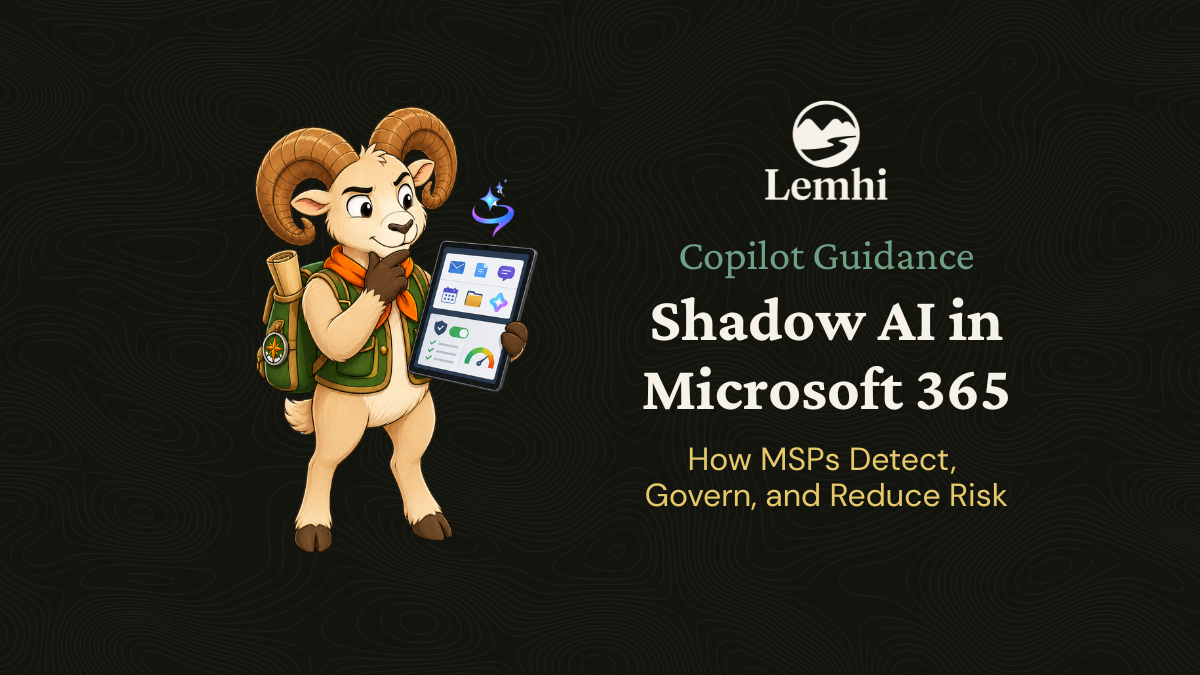
Shadow AI in Microsoft 365: How MSPs Detect, Govern, and Reduce Risk
This article has been written by Tim Hickle
Shadow AI is any AI tool that employees use for work purposes without the organization's approval, monitoring, or governance. In Microsoft 365 environments, shadow AI typically shows up as personal ChatGPT or Claude accounts pasted with company data, browser-based AI extensions, ungoverned Copilot agents, and consumer-grade summarizers running over confidential email. Shadow AI is the single largest source of unmanaged AI risk inside SMBs in 2026 — and it is the failure mode that AI Acceptable Use Policies, Continuous Scanners, and the VCAIO role exist to address.
How MSPs Detect and Govern Shadow AI in Microsoft 365
Shadow AI is the conversation your SMB clients are about to ask you about, whether or not they know the term yet. CoreView's 2026 State of AI in Microsoft 365 report found that 70% of C-suites encourage AI use, but 53% of admin teams say AI is deploying faster than the safeguards. That gap is shadow AI in plain language. Microsoft now publishes shadow AI guidance on Microsoft Learn. New entrants like OpenClaw and Agent 365 are tooling against it specifically. The category is heating up.
For MSPs, shadow AI is both a risk surface and a revenue surface. It is a risk surface because the data exposure is real: confidential client information, financial detail, customer PII, and IP routinely end up pasted into consumer-grade chat windows. It is a revenue surface because shadow AI is the most concrete, most leadership-visible reason an SMB needs a TaaS practice. Nobody on the executive team has to be convinced shadow AI matters.
The MSP playbook is four steps.
- Inventory. Use observability (egress monitoring, SaaS sprawl detection, browser-extension audits, the Continuous Scanner against M365) to build a real picture of which AI tools are in use, by whom, and against which data sources. Self-report surveys are not enough — employees underreport.
- Categorize. Each tool falls into approved, conditional, or blocked. The categories are decided in the AI Council by the executive sponsor on the VCAIO's recommendation. Document the rationale.
- Govern. Write the AUP to match the inventory. Update sensitivity labels and conditional access policies so that high-classification data cannot reach blocked tools. Train employees on the categories with concrete examples.
- Enforce continuously. Re-scan the environment every month. Surface AUP violations to the VCAIO. Bring high-volume violations to the Council. Refresh training when a new tool category emerges.
The mistake most MSPs make is treating shadow AI as a one-time discovery exercise. By the time the inventory report ships, a new wave of consumer AI features has already entered the environment. The Continuous Scanner exists because the inventory has to be a running process.
Why Shadow AI Is the SMB Risk Surface That Cannot Wait
For SMB leadership, shadow AI is the version of AI risk that does not require a technical briefing to understand. Your employees are using AI to do their jobs. Most of them are doing it through personal accounts. None of those accounts are governed by your IT team. Whatever your AI policy says, the actual behavior in your environment is happening one browser tab away from your data.
The exposures are concrete:
- Confidential client data pasted into consumer chat windows. Once in, gone — depending on the vendor's training and retention policy.
- Regulated data (HIPAA, financial records, PII) processed by tools that have no compliance footprint.
- IP and product plans summarized by an AI tool the company has no contract with.
- Customer correspondence routed through summarization extensions that have access to entire inboxes.
The fix is not banning AI. Banning AI inside an SMB in 2026 is the same as banning email in 2002 — it doesn't work, and it makes you uncompetitive. The fix is governing AI: an approved list, a real AUP, employee training, continuous monitoring, and a Council that revisits all four when the landscape shifts. IBM's 2025 Cost of a Data Breach report found breaches involving shadow AI cost more on average than fully governed environments — the math favors the practice.
How Lemhi Powers Continuous Shadow AI Discovery for MSPs
Lemhi treats shadow AI as a continuous discipline, not a project deliverable.
- The Continuous Scanner runs against client M365 environments throughout the engagement. Permissions, sensitivity labels, sharing risk, agent inventory, and shadow AI signals surface to the PSA ticket queue as findings, not as a one-time report.
- Standardized AUP templates. First draft in Phase 1, revised in Phase 3 based on observed real-world usage. Reviewed in every Monthly AI Council. The AUP evolves with the environment.
- AI Council shadow AI segment. The Council's Measurement Review block surfaces shadow AI signals each month — what tools showed up, what data they touched, what owners need to act.
- Coordination with the VCISO. Where shadow AI overlaps with security posture or data classification, the VCAIO and VCISO coordinate. The MSP delivers both motions without duplicating the work.
- Engage-led discovery. Lemhi Engage's Tenant Readiness check surfaces shadow AI signals during Phase 0, so the proposal the MSP brings to the SMB already names the problem in dollar terms.
Shadow AI is not solvable by tooling alone. It is solvable by the practice — a VCAIO who owns the AUP, a Council that makes the decisions, and a Continuous Scanner that keeps the inventory current. Lemhi is how MSPs deliver that practice at portfolio scale.
Build the AI service line your clients are already asking for.
Every week, we send practical guidance for MSPs turning AI from scattered conversations into a repeatable managed service. No hype. No generic AI takes. Just the operating playbook.
For MSP leaders building the next recurring revenue category.
Shadow AI FAQ
Practical answers for MSPs helping SMBs detect shadow AI, reduce over-permissioning risk, enforce approved tool use, and govern AI through the VCAIO and Monthly AI Council.
What is shadow AI?
Shadow AI is any AI tool an employee uses for work purposes that is not approved, monitored, or governed by the organization. Most often, this means personal ChatGPT, Claude, Perplexity, or Gemini accounts, browser-based AI extensions, or ungoverned Copilot agents.
How is shadow AI different from shadow IT?
Shadow IT is unapproved software. Shadow AI is unapproved cognitive tooling. The difference matters because AI tools process data semantically. They do not just transmit it; they may learn from it, retain it, or generate new outputs from it.
How do MSPs detect shadow AI?
MSPs detect shadow AI through a combination of observability surveys, network egress monitoring, browser-extension audits, SaaS sprawl detection, and the Continuous Scanner against M365. No single signal is sufficient. Detection is multi-source.
What's the most common shadow AI tool in SMB environments today?
The most common shadow AI tools in SMB environments are personal ChatGPT accounts and browser-based summarization extensions. Both are easy to install and invisible to most IT logging.
What's the relationship between shadow AI and over-permissioning?
Over-permissioning amplifies the blast radius. When ungoverned AI queries overly-permissioned data, sensitive content leaks faster and at greater volume.
Does an AI AUP stop shadow AI?
Not by itself. The AUP sets the rules, but detection, enforcement, training, and a Council that revisits the AUP based on real usage are what make it operative.
How often should the shadow AI inventory be refreshed?
The shadow AI inventory should be refreshed continuously. Lemhi's Continuous Scanner runs against M365 every month, and the AI Council reviews findings each month.
Is shadow AI illegal?
Not categorically, but it routinely violates internal policies, vendor contracts, and regulatory frameworks such as HIPAA, PCI, GDPR, and state privacy laws. The legal risk is determined by the data, not the tool.
How do we handle employees who are already using shadow AI productively?
There are two paths: approve the tool with conditions such as a vendor agreement, data classification limits, and monitoring, or migrate the workflow to an approved tool. Punishing productive employees usually backfires.
What's the role of sensitivity labels in shadow AI mitigation?
Sensitivity labels in M365 let you enforce data classification at the file and message level. Combined with conditional access policies, they can prevent high-classification data from being shared with non-approved tools.
What's a realistic timeline to reduce shadow AI in a 200-employee SMB?
A realistic timeline is 90 days to inventory, AUP, training, and conditional access, then 6–12 months to bring measurable reduction in detected usage. The goal is governance, not elimination.
Does the VCAIO or the VCISO own shadow AI?
The VCAIO owns AI-specific governance, including shadow AI. The VCISO coordinates on overlapping data-classification and security-posture concerns. The Council brings them together monthly when needed.
How does the Monthly AI Council surface shadow AI?
The Measurement Review segment includes the Continuous Scanner output. Detected tools, data touched, and employee owners are brought into the room with the executive sponsor and department heads.
Can Microsoft Copilot replace shadow AI tools entirely?
For many M365 workflows, yes, once employees are trained on it. Copilot's enterprise grounding and data boundary make it preferable to consumer ChatGPT for company data. But Copilot does not replace every consumer tool, so the AUP still has to address the gap.
How is shadow AI different from "agent sprawl"?
Shadow AI is ungoverned tool usage. Agent sprawl is ungoverned agent creation, usually inside Copilot Studio or similar platforms. Both are governance failures, and both feature in the Council's monthly review.
Where can I learn more?
Lemhi publishes the AUP template, the shadow AI inventory framework, and the Continuous Scanner methodology as part of the TaaS practice. Sign up for Field Notes to get the weekly playbook.
Scale AI transformation across your entire book of business.
Most MSPs are stuck selling AI as scattered projects, Copilot rollouts, or one-off workshops. The MAGIC Framework gives you a repeatable path to package, sell, deliver, and manage AI Transformation as a Service across your client base.
For MSPs ready to turn AI demand into a managed service motion.