
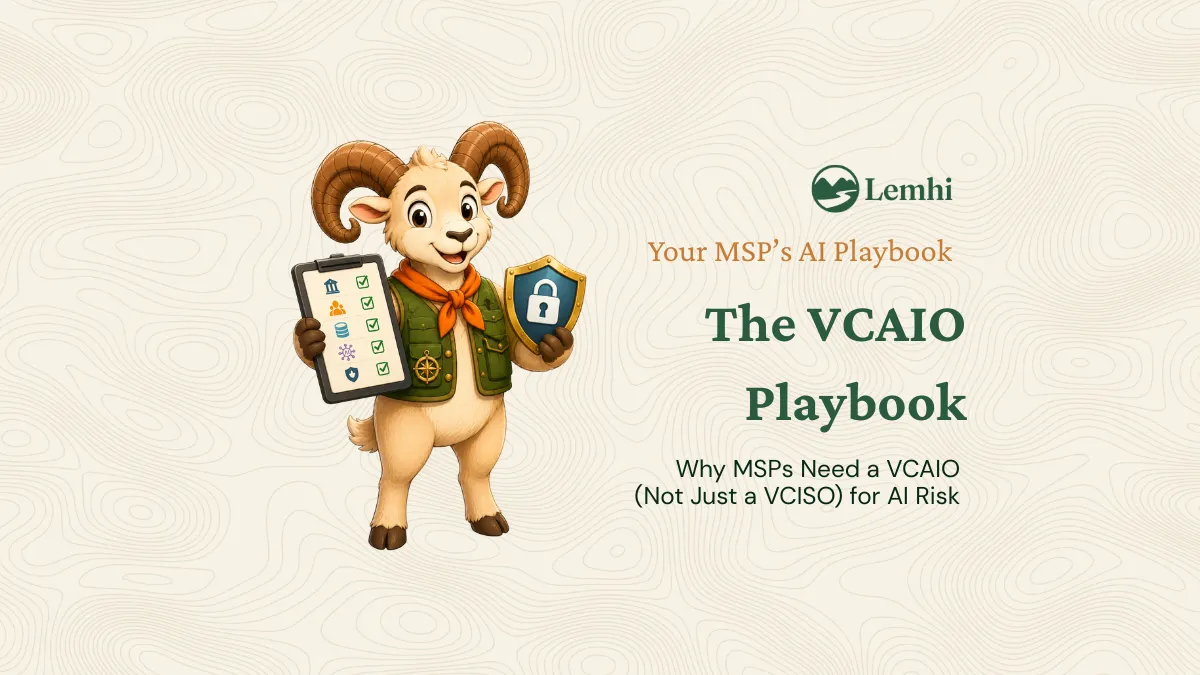
The Virtual CISO (vCISO) and Virtual Chief AI Officer (VCAIO) are adjacent roles, not duplicate ones. The vCISO owns enterprise security posture and compliance frameworks. The VCAIO owns AI-specific governance — acceptable use, shadow AI, data classification for AI use, and the AI Policy. Where they overlap (data classification, sensitivity labels, identity for Copilot), the two coordinate. The VCAIO does not write the security program. The VCISO does not write the AI roadmap. Both report to the same executive sponsor on shared concerns.
Why MSPs Need a VCAIO and a VCISO to Sell AI Risk
For MSPs, the VCISO/VCAIO boundary is one of the most commercially important distinctions in the 2026 channel. Drawing it correctly lets MSPs sell both practices in the same client without scope confusion. Drawing it incorrectly — collapsing AI into the vCISO motion — leaves significant revenue on the table and shortchanges the client’s AI program.
What the vCISO owns:
-
Enterprise security posture. Risk frameworks, control catalogs, audit readiness.
-
Compliance frameworks. SOC 2, HIPAA, PCI, ISO 27001, NIST CSF, state privacy laws.
-
Incident response strategy. Breach detection, escalation paths, regulatory notification.
-
Vendor risk. Third-party assessments, contract review for security clauses.
-
Identity and access posture. MFA, conditional access, privileged access management.
What the VCAIO owns:
-
AI strategy. Roadmap, use case sequencing, Maturity Score.
-
AI governance. AUP authoring and enforcement, shadow AI inventory, data classification for AI use.
-
AI adoption and absorption. Training, manager modeling, Council facilitation.
-
AI observability. Active users, agent invocations, observability vs. survey alignment.
-
AI-specific incident response. Coordination with VCISO on overlap, but VCAIO leads on AI-specific incidents (model hallucination, prompt injection, data leakage into AI tools).
Where they overlap:
-
Data classification. Both roles use sensitivity labels. The VCISO sets the classification scheme; the VCAIO applies it to AI use.
-
Conditional access for Copilot. Both roles coordinate on Copilot identity and access policies.
-
Shadow AI as a security exposure. The VCAIO leads on AI-tool inventory; the VCISO advises on the broader exposure surface.
-
Compliance with AI-specific regulation. EU AI Act, NIST AI RMF, state-level AI disclosure laws — joint workstream.
The commercial logic for MSPs: a client paying for a vCISO retainer does not have an AI strategist in the relationship. The VCAIO sells separately. Most SMB AI risk — the AUP, shadow AI, the use case roadmap, the manager-modeling effect — falls in the VCAIO’s lane, not the vCISO’s. An MSP that sells only vCISO is missing the AI-side practice.
How SMBs Recognize the VCAIO vs. VCISO Boundary in Their Own AI Risk
For SMB executives, the VCISO/VCAIO question shows up as a buying decision: we have a vCISO. Do we also need a VCAIO? The honest answer for most SMBs in 2026 is yes — because the two roles are adjacent, not duplicate.
The fastest test:
-
Who at our MSP owns our AUP? If the answer is the vCISO, the AUP is probably under-developed because the vCISO’s focus is broader security posture. The VCAIO is the dedicated owner.
-
Who runs our Monthly AI Council? The vCISO doesn’t run AI Councils. The VCAIO does.
-
Who tracks our AI Maturity Score? Not the vCISO. The VCAIO.
-
Who decides which Copilot use cases we ship next? Not the vCISO. The VCAIO.
-
Who responds when ChatGPT shows up on the network without authorization? Joint — the VCISO on the security exposure, the VCAIO on the AUP and adoption response.
If your vCISO is trying to cover the AI lane, the practice is likely thin in both directions. The vCISO motion gets diluted; the AI motion never gets the dedicated strategist it requires. The fix is naming both roles.
How Lemhi Formalizes the VCAIO/VCISO Boundary for MSP Delivery
Lemhi formalizes the VCISO/VCAIO boundary inside the platform so MSPs can sell and deliver both motions without scope confusion.
-
Authority-level charter. The Phase 0 engagement charter explicitly maps VCAIO authority (operational, tactical, strategic) and identifies the VCISO coordination points.
-
Joint governance workstream. The platform supports shared work on data classification, conditional access, and AI-specific compliance — without overlap or duplication.
-
Council and QBR coordination. The vCISO can attend the Monthly AI Council as a contributor when security topics are on the agenda. The VCAIO can present in the security QBR when AI-specific findings warrant it. Neither role assumes ownership of the other’s domain.
-
PSA integration. Technical remediation findings — whether they originate from the Continuous Scanner (VCAIO) or the vCISO assessment — flow to the same PSA queue, sequenced by impact.
-
Career path clarity. Lemhi defines distinct competency profiles for VCAIOs and VCISOs, so MSPs can hire and develop for each role specifically.
Selling both motions is the MIP strategy. Selling neither, or collapsing them, is how MSPs leave revenue and client value on the table.