
The Managed Intelligence Provider (MIP): What Comes After the MSP
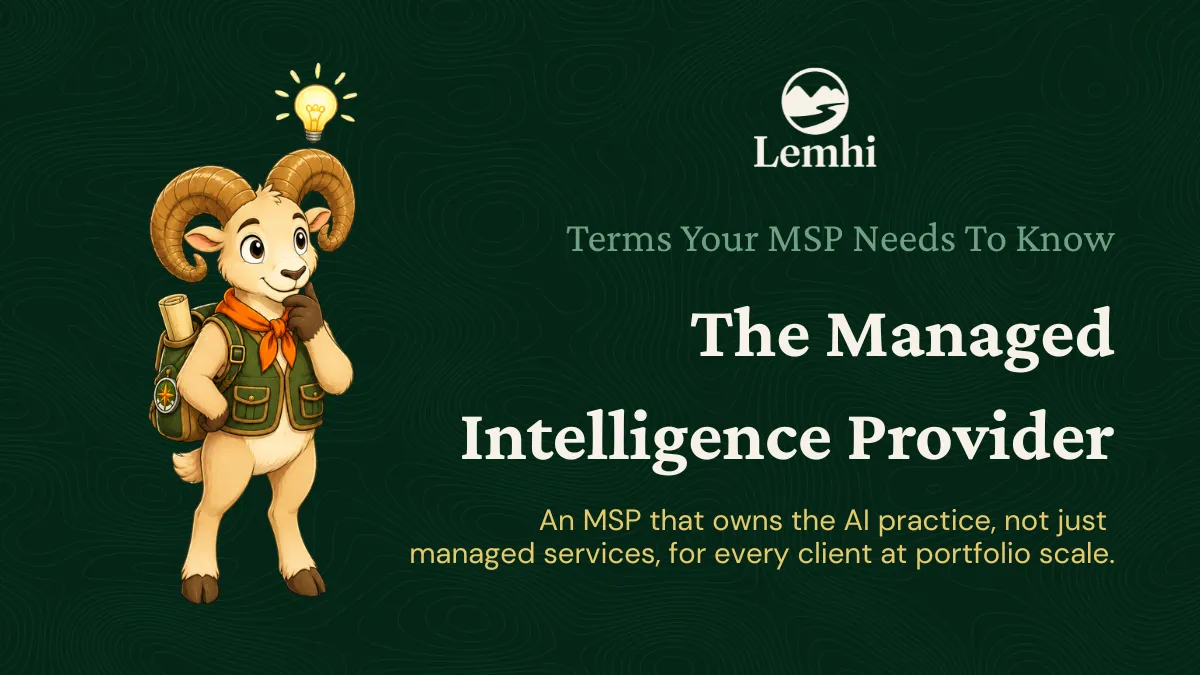
A Managed Intelligence Provider, or MIP, is the next-stage evolution of the MSP. The MIP owns the AI practice for every client at portfolio scale — operating Transformation as a Service, naming a VCAIO inside every relationship, running Monthly AI Councils, reporting AI ROI in every QBR. The MIP category is the natural successor to Managed Services and Managed Security: where the MSP owned uptime, and the MSSP owned security posture, the MIP owns the strategic intelligence layer.
How MSPs Become Managed Intelligence Providers in 2026
For MSPs, becoming a Managed Intelligence Provider is the maturation arc the channel has been working toward since AI demand became unavoidable. The MIP framing answers a question every MSP owner has asked: what’s our category in three years if AI is in everything?
The arc tracks cleanly with prior generations of managed services.
-
Managed Services (2000s–present) owned uptime. The pitch was “we keep your IT running so you can focus on your business.”
-
Managed Security (2010s–present) owned security posture. The pitch was “we manage your risk so you can focus on growth.”
-
Managed Intelligence (2026 and forward) owns the AI practice. The pitch is “we own your AI transformation so you absorb AI into how work gets done.”
Becoming a MIP is not about adding an AI line item to the SOW. It is about restructuring the business around three operating motions: TaaS as the commercial wrapper, the VCAIO as the named strategist, and the Monthly AI Council as the leadership room. That structural change is what produces the MIP outcome.
Why this matters for MSP economics:
-
Recurring revenue. TaaS retainers compound. Adoption-as-a-project does not.
-
Defensible client relationships. Once a VCAIO is named and the Council is on the calendar, displacement risk drops. The competing MSP has to displace a strategist, not just a vendor.
-
Higher contract value. MIPs sell at higher ACV than traditional MSPs because the practice carries more strategic weight inside the client’s leadership team.
-
Talent retention. MSPs that name a VCAIO role create a career path that retains senior delivery talent. Talent that has nowhere to go inside the MSP eventually goes elsewhere.
The channel context: Pax8 Pulse research found 84% of SMBs trust their MSP to lead their AI direction. CRN reported Microsoft’s Judson Althoff calling managed services the partners’ AI “superpower.” Lansweeper found 90% of MSPs say AI is vital but only 41% report meaningful integration. The market is ready for the MIP transition. The question is which MSPs move first.
Why SMB Buyers Should Look for a Managed Intelligence Provider
For SMB executives, the MIP distinction is most useful as a buying criterion. When you are evaluating an MSP for AI work, the question is no longer “do you support Copilot?” — every MSP does. The question is whether the MSP is operating as a Managed Intelligence Provider.
The MIP test fits on a short checklist:
-
Do they offer Transformation as a Service (or an equivalent monthly managed retainer that absorbs onboarding), or do they price AI as a fixed-fee project?
-
Do they name a VCAIO as part of the engagement, or is the AI conversation distributed across whoever picks up the phone?
-
Do they run a Monthly AI Council with your executive sponsor, or do AI decisions happen in IT tickets?
-
Do they report AI ROI in your QBR, or is AI invisible to your board?
-
Do they operate a Continuous Scanner against your M365 environment, or do they assess once a year and call it done?
If the answer to most of those is no, your MSP is still operating as a Managed Services Provider. That may be fine for your IT needs. It is not fine for your AI program.
How Lemhi Powers the Managed Intelligence Provider Transition
Lemhi is the operating-model SaaS that makes the MIP transition possible at portfolio scale. The platform was built specifically because the Lemhi founding team — 45+ years of combined MSP and SaaS experience across two prior MSP SaaS exits — kept seeing MSPs try to make the transition without the operating system underneath.
-
Lemhi Engage (GA June 2026) runs the Phase 0 sales motion that converts a traditional MSP-client AI conversation into a TaaS retainer. The output is a packaged proposal the MSP closes as Managed Intelligence revenue, not as a one-time consulting bill.
-
VCAIO tooling makes the named strategist role sustainable across 12–35 clients depending on engagement mix. Without automation, the VCAIO role does not scale.
-
Standardized Practice artifacts — Council agenda, QBR slides, Maturity Score, AUP template — mean every MIP engagement ships the same way. Standardization is what separates a practice from heroics.
-
Continuous Scanner maintains M365 hygiene continuously, surfacing findings to the PSA queue. The Scanner is what keeps the MIP relationship strategic instead of reactive.
-
Career path for VCAIOs. Because the platform handles the repetitive prep, MSP delivery talent can specialize on the parts of the role that compound — sponsor relationships, in-room judgment, use case sequencing.
The thesis is direct. The MSP category is moving toward Managed Intelligence whether or not individual MSPs make the move deliberately. Lemhi exists to make the deliberate move repeatable.