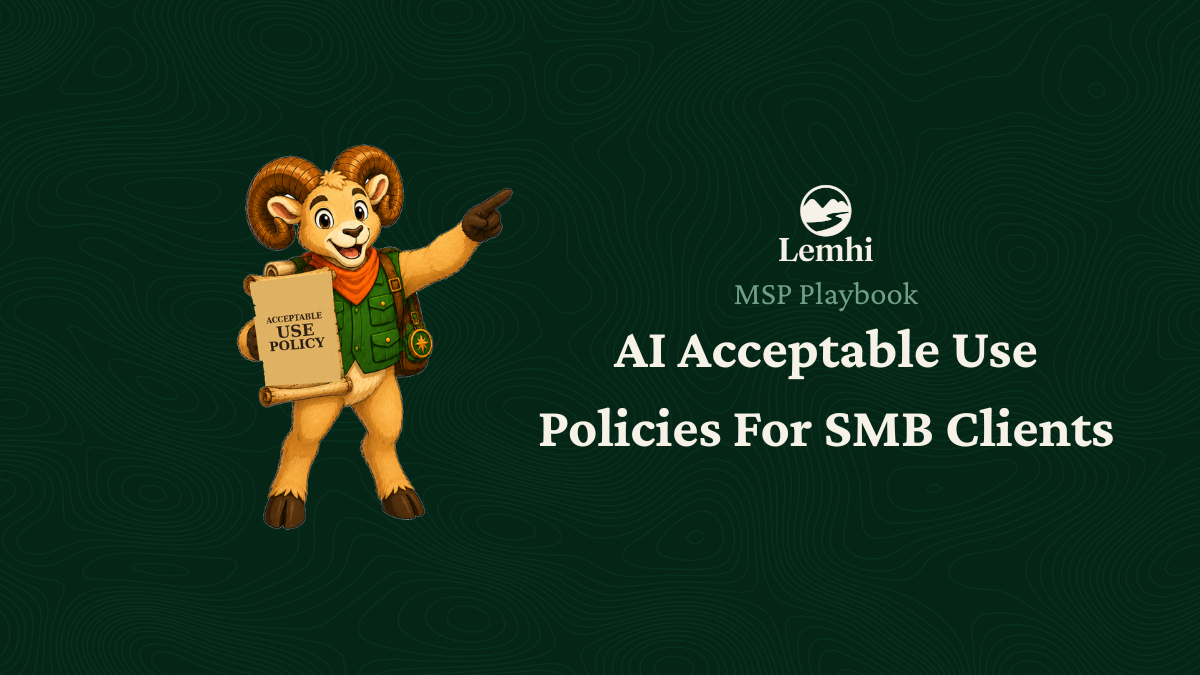
AI Acceptable Use Policy for SMB Clients: The MSP Playbook
This article has been written by Tim Hickle
Most SMB clients are already using AI. They just have not told you about it yet. Employees are pasting customer data into ChatGPT, using AI writing tools on company devices, and experimenting with browser-based assistants that have no connection to your security stack. By the time a client mentions AI in a QBR, the exposure is already there.
That is exactly why the AI acceptable use policy deserves to be the first thing you raise in every AI conversation, not the last. It is not a formality or a legal checkbox. It is a diagnostic tool. The way a client responds to the question "do you have an acceptable use policy for AI?" tells you almost everything you need to know about their current risk posture, their readiness for AI adoption, and how much governance work lies ahead.
This post walks through how to use that single question as a structured entry point into the broader security and data governance conversation, and how to turn it into a repeatable process across your client base.
Why the Acceptable Use Policy Question Works as an Opener
Ask a client whether they have an AI acceptable use policy and you will get one of three responses. They say yes and can show you the document. They say yes but cannot produce it, which usually means it was copied from a template and never operationalized. Or they say no, which is the most common answer, and the most honest.
Each response is useful. The client who has a documented, enforced policy is ahead of the curve and ready for a more sophisticated conversation about AI integration. The client who thinks they have a policy but cannot locate it has a governance gap that is easy to articulate and straightforward to fix. The client who has nothing is starting from zero, and that is actually the cleanest starting point because there are no assumptions to undo.
The question also sidesteps the hype problem. Many SMB owners feel pressure to adopt AI but are not sure where to start. Asking about governance reframes the conversation from "what AI tools should we use" to "what guardrails do we need first." That shift puts you in the role of a trusted advisor rather than a vendor pushing products.
What Does an AI Acceptable Use Policy Actually Cover?
An acceptable use policy for AI is not a general IT acceptable use policy with a paragraph added at the bottom. It needs to address a distinct set of risks specific to how AI tools process, store, and transmit information.
At minimum, a solid policy covers four areas:
- Approved and prohibited tools. Define which AI tools employees may use and which are explicitly off limits.
- Data input boundaries. Specify what categories of data are permitted inside AI systems and what is not, including customer PII, financial records, and proprietary business information.
- Output handling. Establish how employees should treat AI-generated content before acting on it or sharing it externally.
- Accountability. Identify who owns AI governance and what the reporting process looks like when someone encounters a problem or makes a mistake.
For SMB clients, you do not need a 30-page document. A one-to-two page policy that employees can actually read and remember is more effective than a comprehensive framework sitting in a shared drive untouched. The goal is behavioral change, not documentation for its own sake.
How Does the Policy Surface Shadow AI Risk?
Shadow AI is the MSP equivalent of shadow IT, and it is growing faster. Employees are adopting AI tools at a rate that outpaces any formal procurement or security review process. The risk is not hypothetical. Customer data entered into a public AI tool may be used for model training, stored on servers outside your client's jurisdiction, or exposed if that vendor has a breach.
When you ask about an acceptable use policy and find that one does not exist, your next move is a short discovery conversation about what tools employees are currently using. Frame it as inventory, not interrogation. You are trying to understand the current state so you can build appropriate guardrails.
What you are looking for is any tool that processes business data outside the approved technology stack. That includes AI features embedded in consumer applications, browser extensions with AI functionality, and standalone tools employees signed up for with personal email addresses. Each of these represents an unmanaged data pathway, and the acceptable use policy gives you the authority to address it.
Connecting the Policy to a Broader Governance Conversation
The acceptable use policy is not the destination. It is the door. Once you have established that a client needs governance around AI, you have a natural opening to discuss the full picture of what responsible AI adoption looks like at the organizational level.
That conversation typically moves in three directions:
- Data classification. Most SMBs have never done this formally, but it becomes essential once AI tools are in play. You cannot define what data is safe to use in AI without first knowing what data you have and how sensitive it is.
- Vendor assessment. This is the process for evaluating AI tools before they are adopted rather than after.
- Incident response. This addresses what happens when an employee uses an AI tool inappropriately or when a vendor has a security event.
None of this requires your client to have a dedicated IT security team. It requires clear ownership, written guidance, and a relationship with an MSP who knows how to implement controls that fit an SMB environment. That is the value you are offering.
Making This a Repeatable Process Across Your Client Base
The clients who ask you for help with AI governance this year will be ahead of the ones who do not. But to make that work at scale, you need a process that does not depend on one person remembering to ask the right questions.
Start by adding the acceptable use policy question to your standard client assessment or QBR template. Make it a required field, not an optional discussion item. This creates a consistent baseline across your entire book of business and surfaces gaps you might otherwise miss with clients who are not actively raising AI concerns.
From there, build a tiered response:
- Clients with no policy get a policy development engagement.
- Clients with a policy but no enforcement mechanism get a governance audit.
- Clients with documented, enforced governance get an AI readiness assessment for deeper integration work.
This gives your team a clear path forward for every client type without starting from scratch each time.
Document your findings in your PSA or wherever you track client risk profiles. AI governance is not a one-time project. It evolves as tools change and as clients grow, and you need a record of where each client stands so you can have an informed conversation six months from now.
The AI acceptable use policy is one of the most efficient tools an MSP has for starting a productive client conversation about AI. It is specific enough to be actionable, broad enough to open the full governance dialogue, and grounded in a real risk that clients can understand without needing a technical background. Every client conversation about AI should start here.
If you want a structured methodology for building these governance conversations into a repeatable client engagement model, the MAGIC Framework gives you the controls-first approach that makes that possible at scale.
Scale AI transformation across your entire book of business.
Most MSPs are stuck selling AI as scattered projects, Copilot rollouts, or one-off workshops. The MAGIC Framework gives you a repeatable path to package, sell, deliver, and manage AI Transformation as a Service across your client base.
For MSPs ready to turn AI demand into a managed service motion.
AI Governance Conversation FAQ
Practical answers for MSPs introducing AI acceptable use policies, addressing shadow AI, and making governance feel like trusted advisory instead of a product pitch.
How do I bring up AI governance without it sounding like I'm selling something?
Frame it as a risk conversation, not a product conversation. Ask whether the client has an acceptable use policy as part of your standard security review. If they do not, explain why it matters in plain language, referencing real scenarios like data exposure through consumer AI tools. The goal is to establish credibility as an advisor before you discuss any specific service or solution.
What if a client says they don't use AI and doesn't think a policy is necessary?
This is a common response, and it is usually inaccurate. Employees use AI tools independently of whether leadership has sanctioned them. Walk the client through the concept of shadow AI and ask if they have visibility into which tools their team is using on company devices. That question usually changes the conversation quickly.
How detailed does an acceptable use policy need to be for a small business?
It should be long enough to cover approved tools, data handling rules, output use guidelines, and accountability, but short enough that an employee can read it in five minutes. One to two pages is the right target for most SMBs. A policy that no one reads provides no protection.
Can I use a template policy or does it need to be custom?
A template is a reasonable starting point, but it needs to be customized to reflect the client's actual tools, data types, and industry requirements. A generic policy that references tools the client does not use, or ignores the ones they do, will not hold up when you need it to.
How often should an AI acceptable use policy be reviewed?
At minimum, annually. In practice, the AI landscape changes fast enough that a review every six months makes sense for most SMBs. Any time a client adopts a new AI tool or a major vendor changes their data handling practices, the policy should be revisited to confirm it still reflects current reality.
Build the AI service line your clients are already asking for.
Every week, we send practical guidance for MSPs turning AI from scattered conversations into a repeatable managed service. No hype. No generic AI takes. Just the operating playbook.
For MSP leaders building the next recurring revenue category.