
AI Practice vs. AI Program: The Distinction That Makes MSPs Profitable
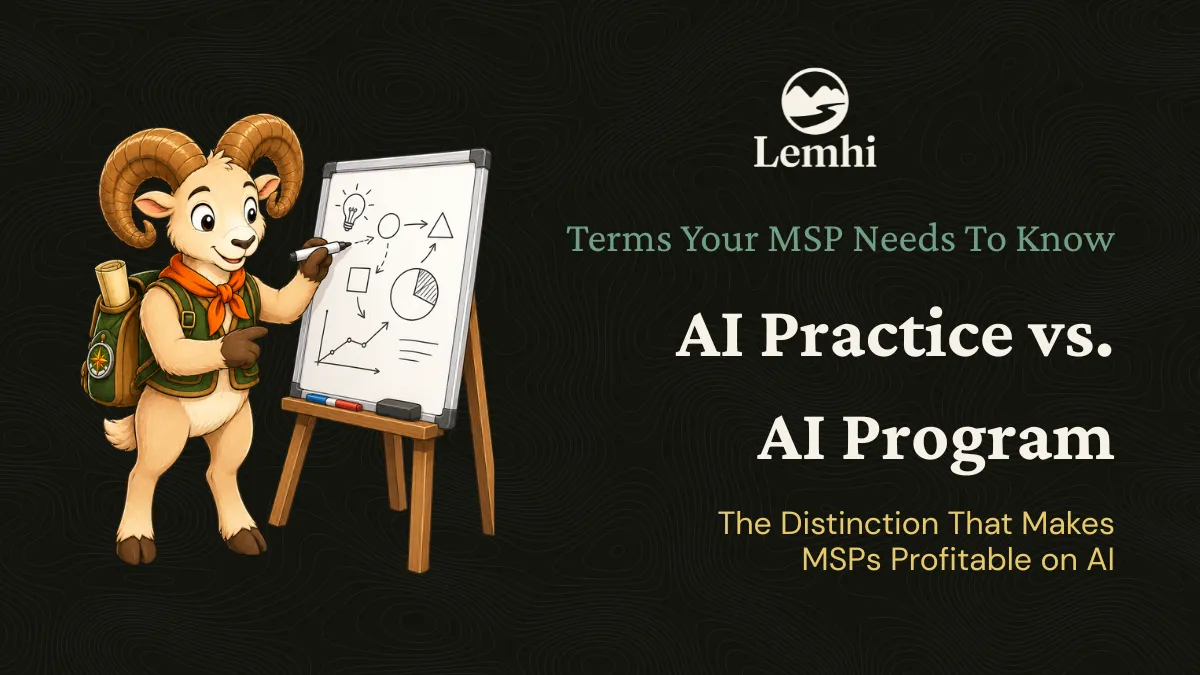
The AI Practice is the commercial offering an MSP sells — the packaged, repeatable service the MSP delivers across its client book. The AI Program is the portfolio of AI work, owners, outcomes, and policies that the client runs internally. The MSP’s AI Practice supports the client’s AI Program. Lemhi’s vocabulary deliberately separates the two because mixing them is the most common cause of scope creep, margin erosion, and accountability confusion in MSP AI work.
How the AI Practice vs. AI Program Distinction Protects MSP Margin
For MSPs, the Practice/Program distinction is a survival tool. Without it, every client conversation drifts into questions like “can you also help us with this internal initiative” — and the MSP either says yes and loses margin or says no and damages the relationship. With it, the boundary is clear: the MSP delivers the Practice, the client owns the Program, and the VCAIO is the connective tissue.
What the Practice owns:
-
The commercial structure. Pricing, scope, SLAs, escalation paths.
-
The named role. The VCAIO who carries the relationship.
-
The recurring artifacts. Monthly AI Council, QBR AI Segment, AI Maturity Score, AUP, Continuous Scanner output, training rollout.
-
The standardized playbook. Phase 0–3 onboarding, ongoing cadence, exit criteria.
What the Program owns:
-
The strategic intent. Why the client is investing in AI, what outcomes they want, what risks they will not accept.
-
The internal owners. The executive sponsor, the department heads, the AI Champions inside the client.
-
The decisions. What the Council decides goes into the Program — but the Program is what executes against those decisions.
-
The accountability. When AI helps or hurts the business, the Program is where the consequences land.
The VCAIO is accountable to the MSP for delivering the Practice and accountable to the client for advancing the Program. Both lines of accountability are visible in the Monthly AI Council and the QBR AI Segment.
Where MSPs lose money: when they accept Program-side work (custom agent builds, departmental AI projects, internal change-management initiatives) inside the Practice retainer without re-scoping. The fix is not refusing the work — it is expanding the retainer or selling a separate project alongside the Practice.
What SMB Leaders Should Know About AI Practice vs. AI Program Ownership
For SMB executives, the distinction is the answer to a question your team is probably asking quietly: who owns AI here, us or the MSP? The answer is: you own the Program, the MSP runs the Practice that supports it. Both roles are real.
What this means concretely:
-
You own the strategic outcomes. AI is your investment, your risk, your competitive advantage. Your executive sponsor signs the budget; your department heads commit owners; your employees do the work.
-
The MSP owns the operating discipline. The VCAIO shows up every month. The Council convenes. The QBR reports ROI. The AUP gets revised. The Continuous Scanner runs. The training ships.
-
The handshake is the Monthly AI Council. That is where the Practice and the Program meet — where the MSP’s standardized motion produces decisions the client’s leadership team commits to.
If your AI relationship feels confused — if you can’t tell whether you or the MSP “owns” a particular decision — the fix is to articulate the boundary in the next Council. Most ambiguity disappears once Practice and Program are named separately.
How Lemhi Enforces the AI Practice and Program Boundary in MSP Delivery
Lemhi enforces the Practice/Program distinction inside the platform — which keeps MSPs profitable and clients aligned.
-
Standardized Practice artifacts. The Council agenda, the QBR AI Segment slides, the Maturity Score rubric, the AUP template — all standardized so every Practice ships the same way.
-
Engagement charter. Phase 0 produces a written charter that names the boundary between Practice and Program. Owners on both sides are documented at kickoff.
-
VCAIO authority levels. Operational, tactical, and strategic decisions are pre-delegated or escalated based on the charter — so the VCAIO never has to negotiate authority mid-conversation.
-
Scope-creep guardrails. When Program-side work emerges (custom agent builds, large training initiatives, departmental projects), the platform flags it as outside Practice scope and prompts a re-scope conversation.
-
Compass Module for the Practice/Program edge case. At very small clients, the Practice/Program distinction collapses into the owner-operator. The Compass Module is designed for that reality.
The distinction is not pedantic. It is the operating discipline that makes the difference between an MSP that scales AI revenue and one that bleeds margin on every engagement.