
The Honest Answer
The question comes up in every room right now. Tier-one technicians, help desk staff, early-career MSP folks — they’re watching the AI conversation and wondering where they fit in it. The anxiety is understandable. And anyone who tells you it’s not a real question isn’t being straight with you.
Here’s the honest answer from someone who has watched this pattern play out three times in 30 years of MSP work: the technology isn’t the threat. The refusal to adapt to it is.
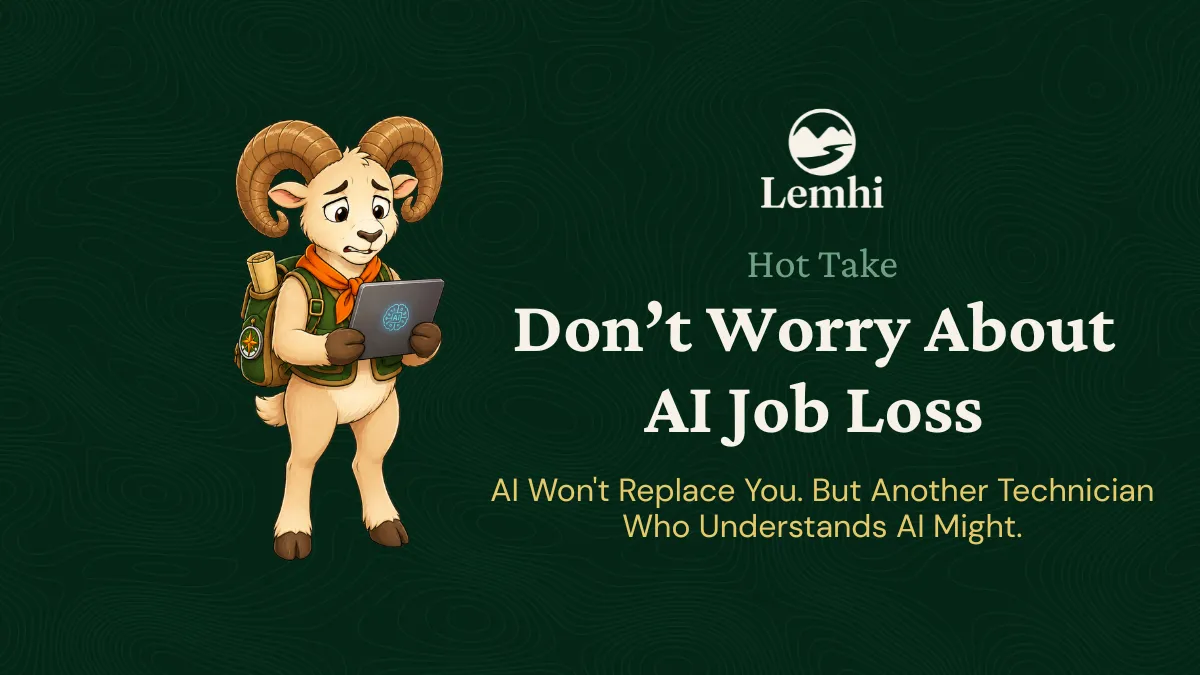
No, AI is not coming for every tier-one job. It is coming for the part of the job that never grows. The technicians who treat AI like the next layer of the stack — something to learn, govern, and configure — are going to do well. The ones who stay parked in repetitive work and call that job security are the ones who should be nervous.
Andy Banning has said it the same way in conversations with MSP partners: keep learning, lean into governance and policy, and remember that cloud made things more complex, not less. The tone is pragmatic, not soft. He is not pretending the repetitive part of tier-one work is safe forever. The instinct is blunt: governance is step 1. If you can help your MSP understand permissions, readiness, policy, and rollout risk before everyone gets turned loose on AI, you are already moving out of the replaceable zone.
They Said the Same Thing About Exchange Admins
In June 2011, Microsoft launched Office 365 and bundled Exchange Online with it. If you were an Exchange administrator at the time, you heard a version of the same fear technicians are expressing today: “Microsoft is going to host their own email. Why would anyone pay us to manage it?”
The fear made sense in the moment. Exchange admins had spent years building expertise in on-premises mail infrastructure. Now Microsoft was offering to run it in the cloud, directly. On the surface, the skill set looked obsolete.
What actually happened: the admins who learned cloud migration, hybrid Exchange configurations, and eventually M365 governance became more valuable than they had been in the on-prem era. The hiring demand for cloud skills grew at six times the rate of IT skills overall through the transition period. The ones who didn’t adapt didn’t get replaced by Microsoft. They got replaced by other technicians who moved faster.
What separated the Exchange admins who stayed valuable from the ones who got squeezed was not deeper attachment to Exchange. It was willingness to move one layer up. Cloud shifted the work from keeping one server healthy to handling migration, enablement, permissions, governance, and the user change management around it. During the server-to-cloud transition, MSPs started adding professional-services capability around the technical core instead of treating the old infrastructure lane as the whole job.
That is the map for AI. The question MSPs ask most often right now is about Copilot enablement and Microsoft consumption. The technician who learns the new admin surface becomes more useful. The one who waits for the old surface to matter again gets boxed in.
And Before That, Break-Fix Technicians
Before the Exchange admin anxiety, there was the break-fix transition. When managed services emerged in the mid-2000s, break-fix technicians had a version of the same concern. If the job is to fix things when they break, what happens to that job when things stop breaking as often because the MSP is preventing problems proactively?
The answer, again, was that the technology created more complexity, not less. The break-fix technicians who moved into managed services learned to think preventively: monitoring, patch management, standardized configurations, documentation. That required more skill and more judgment than reactive hourly work, not less. The ones who made the shift became the backbone of the early MSP model. The ones who didn’t found themselves on the wrong side of a market that had moved on.
The break-fix technicians who made the jump were the ones who stopped seeing value as “I can fix it fast” and started seeing value as “I can stop it from breaking in the first place.” That is a mindset shift before it is a tooling shift. The old model was infrastructure custodian work. The next model required becoming a business enabler rather than the person who just said no. That posture change is exactly what tier-one techs need to make right now.
The people who struggled in that era had the same issue techs face today with AI: they were excellent inside the current queue, but they didn’t want to learn the adjacent discipline. Managed services rewarded documentation, standardization, monitoring, and change control. AI is going to reward readiness assessment, policy, permissions, rollout discipline, and practical enablement. Different tools, same career pattern.
The Pattern Is Always the Same
Two transitions, same arc. A technology shift creates a fear response. The fear is that the new technology will eliminate the need for the technician. What actually happens: the technology creates new complexity, new service categories, and new demand for people who understand it, while reducing demand for people who only know how to do the thing the technology has taken over.
The data from the current AI transition confirms the same arc is running again. Help desk job postings have declined 36% since 2020 as AI-driven tools automate routine tasks. Simultaneously, CompTIA reports that AI skill requirements in job postings nearly doubled in a single year: from just over 5% of postings in 2024 to over 9% in 2025. More than 275,000 active U.S. job postings in January 2026 specifically referenced AI skills.
The overall tech workforce is projected to grow by 1.9% in 2026, adding nearly 185,500 new jobs. The net employment picture in tech has always gone up through these transitions. What shifts is which skills are doing the growing.
The cloud transition created the cloud architect, the cloud engineer, the cloud security specialist: roles that didn’t exist in the on-prem era. The cyber transition expanded security operations roles by an order of magnitude. AI is creating demand for AI governance administrators, Copilot deployment specialists, and policy configuration technicians. These roles didn’t exist three years ago. They’re in job postings now.
What Actually Gets Replaced (And What Doesn’t)
The 70% figure is worth looking at directly. Gartner estimates that roughly 70% of tier-one IT tickets are theoretically automatable by AI. If you’re a tier-one technician, that number deserves a straight read: a meaningful share of what you do today can be handled by an AI ticketing tool.
Password resets. Basic connectivity troubleshooting. Standard ticket routing. Status updates. Software access requests. These are the tasks at the bottom of most tier-one queues, and AI tools are already handling them in environments that have deployed them.
The honest framing isn’t “AI can’t do your job.” It’s “AI is doing the lowest-context part of your job. What are you doing with the time that frees up?”
The technicians who are in trouble are the ones whose entire job is in that automatable zone and who aren’t actively building skills above it. The technicians who are well-positioned are the ones using the automation to move up the stack: to the configuration, governance, troubleshooting, and client advisory work that requires judgment and context.
And there’s a new category of work that didn’t exist before AI that a tier-one technician can own right now: managing the AI tools themselves. Configuring Copilot for an SMB client. Running a readiness assessment in SharePoint before a Copilot deployment. Governing which scenarios are enabled and which data sources are accessible. Reviewing Purview AI Observability reports and flagging policy drift. Microsoft has released a dedicated certification for this work: the Microsoft 365 Copilot and Agent Administration Fundamentals exam (AB-900). This is a tier-one growth path. It’s accessible, it’s in-demand, and every MSP deploying Copilot needs someone who can do it.
The first category of tier-one work that AI will touch is the repetitive assistance layer: common IT questions, routine fixes, first-pass documentation, and alert summarization. Lemhi’s own AI use-case library calls out an AI help desk assistant for common questions and routine fixes, AI-generated technical documentation, and AI summaries for alert and log review. That is the work you should expect to shrink first.
The growth path above it is concrete. Start by learning the control plane for M365 Copilot: Exchange Online, SharePoint, Teams, Entra, Purview, and Copilot governance. Lemhi has already started pushing for a lightweight Microsoft Copilot certification track to help technicians get there. That lines up with how Andy Banning is already working in the field: readiness checklists, governance-first reviews, and structured interviews to make sure clients don’t run into snags before AI enablement begins.
The Technicians Who Should Be Paying Attention
Not every tier-one technician’s situation is identical. The ones with the most exposure are those whose work is almost entirely in the repetitive-task tier and who haven’t started building new skills. If every day looks like password resets and basic connectivity calls, and there’s been no movement toward learning how the tools actually work under the hood, the pressure is real.
The ones in the best position are the curious ones. The technicians who want to know how AI ticketing works, why Copilot needs a SharePoint oversharing assessment before deployment, what the Copilot Control System actually does. Curiosity is the skill that survives every transition. It’s what turns the Exchange admin who was afraid of Office 365 into the M365 architect who manages it for a hundred clients.
The specific ask for any tier-one technician reading this: get hands-on with the tools. Understand what Copilot can and can’t do. Take the AB-900 exam. Position yourself as the person in the MSP who manages AI for clients, not the one whose tasks AI manages. The MSPs building Copilot deployment practices right now are creating demand for exactly that technician.
If you’re anxious, don’t start by arguing with the future. Start by volunteering for the messy work everyone else avoids. Learn how to spot overshared SharePoint data. Learn how an AI use policy actually gets rolled out. Learn how to run a basic readiness checklist and explain why data sitting on a local NTFS share is a blocker if the client wants AI search over company knowledge.
The first concrete step: get hands-on with Copilot in a governed Microsoft environment, then study the admin side until you can explain what the user sees, what the admin controls, and where the risks come from. After that, take the AB-900 path and become the person in your shop who can help with readiness checks, policy rollout, and basic Copilot governance. That is a much better bet than trying to protect a queue full of password resets.
The Shift Is Already Happening
The Exchange admins who thrived weren’t the ones who waited to see how Office 365 played out. The break-fix techs who built careers through managed services weren’t the ones who held on to reactive hourly work until clients stopped calling.
Every transition in this industry has rewarded the same thing: the willingness to get curious before you’re forced to, and to build the next skill set while the window is still open.
That window is open right now for AI. The technician who understands governance configuration, policy management, and Copilot administration is the one MSPs are hiring for. The demand is already there. The certification path exists. The clients are asking for the service.
The only thing left is deciding to be the technician who manages AI, not the one who waits to find out if AI manages them.